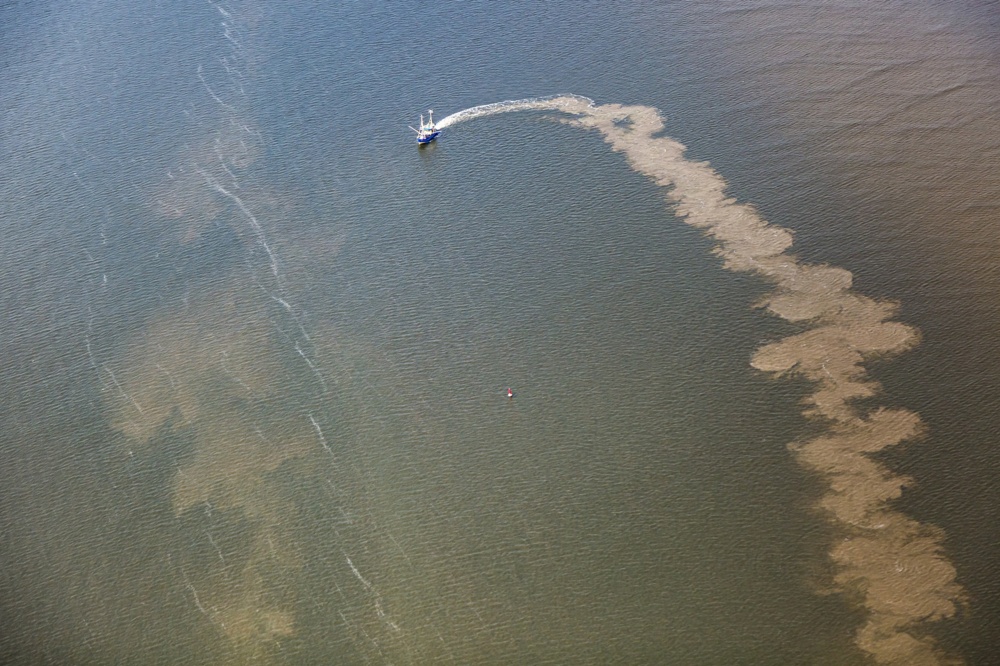
Legal action launched against bottom trawling in the German Wadden Sea
Berlin, 24 June 2026 - Environmental Action Germany (DUH), with the support of the Environmental Justice Foundation (EJF), is taking legal action against bottom trawling in the German Schleswig-Holstein Wadden Sea National Park. Having filed a complaint with the European Commission last year, DUH and EJF are now bringing the case before the Schleswig-Holstein Administrative Court, arguing that the state government is failing to meet its obligations under EU nature conservation law.
DUH and EJF are calling for the mandatory environmental impact assessment to be carried out in line with the EU Habitats Directive, a ban on bottom trawling in the national park, and for the so-called “Marine Protected Area” to be protected in reality, not just on paper.
Every year, more than 36,000 hours of bottom trawling are recorded in protected habitats within the Schleswig-Holstein Wadden Sea National Park. This predominantly involves brown shrimp fishing, with devastating consequences for marine wildlife: vital, legally-protected habitats such as sand coral reefs have disappeared, marine animals persistently end up as bycatch, and the North Sea brown shrimp population is steadily declining.
Sascha Müller-Kraenner, Executive Director of DUH: “In the protected Schleswig-Holstein Wadden Sea National Park, fishing is carried out using one of the most devastating fishing methods in the world. For decades, authorities have refused to carry out the legally required environmental impact assessment, allowing damage to some of Europe's most important marine habitats. The marine protected area must not exist merely as a paper park, and since the state government is failing to act, we are taking legal action.”
For years, authorities, the fishing industry and environmental organisations have attempted, in the so-called ‘Future Dialogue’ on brown shrimp fishing in Schleswig-Holstein, to develop binding measures for the protection of sensitive habitats. The process collapsed last year, meaning that harmful bottom trawling continues to strip life from the seabed in the national park.
This case forms part of a growing movement across Europe to ensure marine protected areas are genuinely protected. Legal action against bottom trawling in MPAs is currently ongoing in France, Germany, Spain and Sweden, and a recent court ruling in France found that current measures are insufficient and that the applicable regulations should be strengthened. In the Netherlands, the District Court of The Hague has ruled that bottom trawlers in the Dutch part of the Dogger Bank marine protected area now need a permit. To get one, they must prove their fishing will not harm marine life within the protected area.
Steve Trent, CEO and Founder of the Environmental Justice Foundation (EJF), said: “Bottom trawling has no place in protected areas. These areas should be refuges where marine life can recover and thrive, supporting abundant wildlife, sustainable fisheries and resilient coastal communities. The continued degradation of protected marine habitats makes no ecological, economic or social sense.
The Schleswig-Holstein Wadden Sea National Park, as well as other European MPAs like Chausey in France, can demonstrate that restoring nature, supporting sustainable fisheries and securing coastal livelihoods are not in competition: they are the same goal.”
ENDS
Notes to editors
Image credit: M.Stock / wattenmeerbilder.de
Background:
Scientific studies have shown for years that bottom trawling causes considerable damage to seabed habitats.
Studies document the decline in biomass and biodiversity, as well as long-term changes to sediment structure and food chains. In response, in April 2025, DUH, together with EJF and other environmental organisations, filed a complaint with the European Commission against France, Germany and Italy, on the grounds that the three countries are systematically failing to fulfil their obligations under EU law to protect vulnerable marine ecosystems.
EU nature conservation law is being disregarded as bottom trawling continues in the national park without the legally required environmental assessment.
DUH and EJF are calling for change after years of inaction from the national park administration and the state government, and for an immediate and total halt to bottom trawling in the national park.
The Wadden Sea case is part of a growing wave of EU legal action: proceedings against bottom trawling in MPAs are currently ongoing in France, Spain, Germany, and Sweden. In the Netherlands, the District Court of The Hague has already ruled against bottom trawlers fishing without a permit in a protected area and mandated risk assessments for receiving permission.
About EJF
Our work to secure environmental justice aims to protect our global climate, ocean, forests, wetlands, wildlife and defend the fundamental human right to a secure natural environment, recognising that all other rights are contingent on this. EJF works internationally to inform policy and drive systemic, durable reforms to protect our environment and defend human rights. We investigate and expose abuses and support environmental defenders, Indigenous peoples, communities, and independent journalists on the frontlines of environmental injustice. Our campaigns aim to secure peaceful, equitable and sustainable futures. Our investigators, researchers, filmmakers, and campaigners work with grassroots partners and environmental defenders across the globe. For more information or to organise an interview with one of our team, please contact media@ejfoundation.org.
About Environmental Action Germany (Deutsche Umwelthilfe (DUH)
Environmental Action Germany (DUH) has been campaigning to preserve the natural foundations of life for more than 50 years. In doing so, it brings together protecting the environment with consumer protection like no other organisation in Germany. For more information or to organise an interview with one of our team, please contact the DUH Newsroom: +49 (0) 30 2400867-20, presse@duh.de.
SIGN UP FOR OUR EMAILS AND STAY UP TO DATE WITH EJF