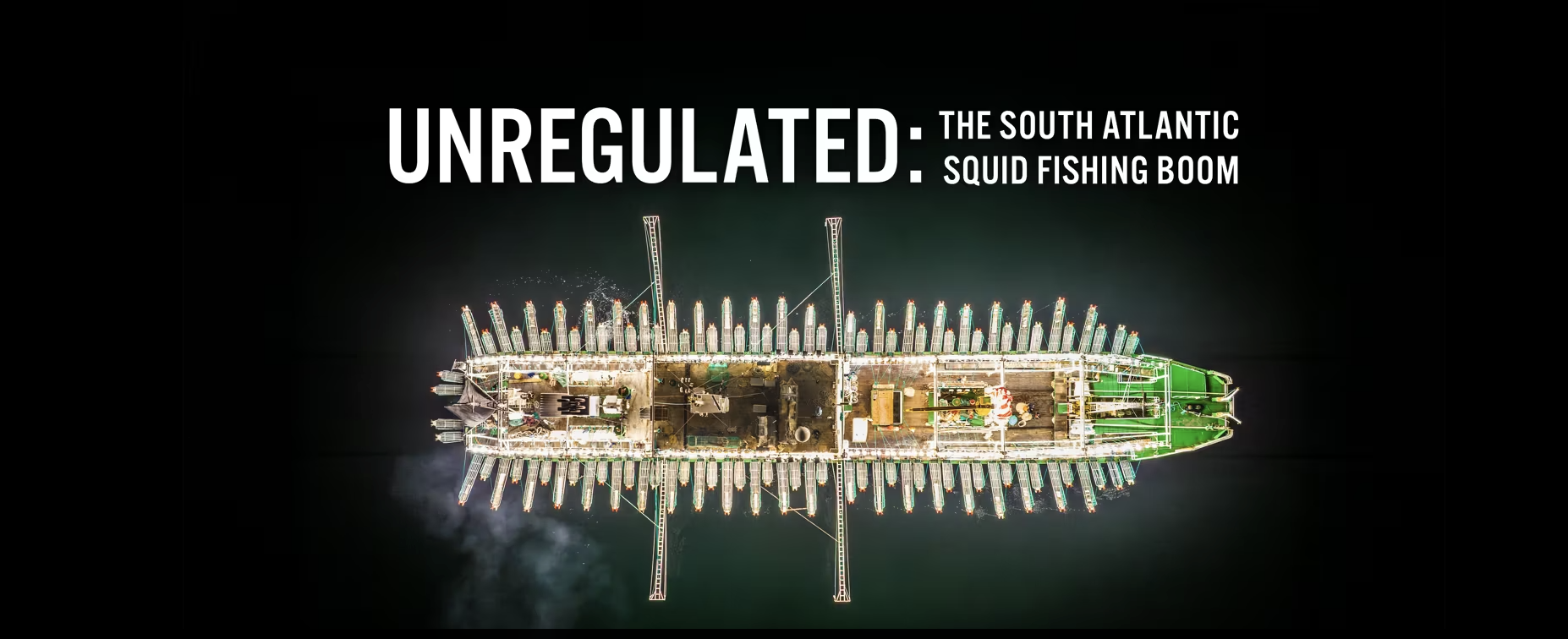
Unseen and unaccountable: EJF investigation exposes governance failures in the South East Pacific squid fishery
February 19th, 2026 - A new investigation from the Environmental Justice Foundation (EJF) reveals how one of the world’s most important squid fisheries is being pushed towards ecological and social crisis, as vast Chinese fishing fleets exploit weak governance, poor transparency and regulatory loopholes across the South East Pacific. Squid caught by one company implicated in some of the worst fisheries and labour abuses, China National Fisheries Corporation, were exported to the USA, EU and the UK.
The report exposes how China’s distant-water squid fleet is operating at an extraordinary scale in the South East Pacific. It targets jumbo flying squid, a keystone species that underpins marine food webs and regional fisheries. Despite clear warning signs of overfishing, fishing effort continues to increase, and regulation has not kept pace.
EJF’s investigation identifies chronic transparency failures across the fleet. This allows destructive fishing, environmental harm and human rights abuses to flourish. Over 50% of the crew members interviewed reported physical abuse, and almost 60% told EJF sharks were finned on their vessels.
“China’s industrial squid fishing fleet in the South East Pacific is operating beyond effective scrutiny,” said Steve Trent, CEO and Founder of the Environmental Justice Foundation. “This investigation shows how a lack of transparency and accountability at the regional level is driving environmental damage and putting lives at risk. Transparency in industrial fisheries can no longer be optional. It is the foundation of a safe, sustainable ocean.”
EJF also highlight serious concerns around bycatch and ecosystem impacts, including the disruption of ocean food webs through intensive fishing. Squid are highly sensitive to environmental change and play a vital role in regulating marine ecosystems. Their overexploitation risks cascading impacts across the wider Pacific Ocean, says EJF.
Arriving immediately before a key meeting of the South Pacific Regional Fisheries Management Organisation (SPRFMO), the investigation emphasises that states must work together now to avoid the fishery collapsing. At the regional level, EJF warns that the SPRMFO has yet to adopt meaningful conservation and management measures for squid, despite growing scientific evidence of declining catch rates and rising fishing pressure. The absence of catch limits, effective monitoring and enforceable safeguards leaves the fishery dangerously exposed, says EJF.
EJF calls on SPRFMO member states to act decisively by introducing science-based catch limits, strengthening monitoring and control measures, and closing loopholes that allow destructive practices to continue unchecked. The report also urges coastal, port and market states to play a stronger role in enforcing compliance and preventing ports and supply chains from enabling abuse.
Central to these reforms is the urgent need for governments to endorse and implement the Global Charter for Fisheries Transparency. The Charter sets out practical, low-cost measures to bring about sustainable, legal and ethical fisheries, including full disclosure of vessel ownership, mandatory tracking, and public access to fisheries data.
“This crisis is solvable,” added Trent. “The tools exist. We don’t even need to look further than this fishery: Peru has significantly reduced illegal fishing in recent years by requiring more tracking data. What is missing is the wider political will. By embracing transparency and acting through SPRFMO, governments can protect a vital fishery, defend human rights, and secure the future of the South East Pacific.”
ENDS
About EJF
Our work to secure environmental justice aims to protect our global climate, ocean, forests, wetlands, wildlife and defend the fundamental human right to a secure natural environment, recognising that all other rights are contingent on this. EJF works internationally to inform policy and drive systemic, durable reforms to protect our environment and defend human rights. We investigate and expose abuses and support environmental defenders, Indigenous peoples, communities, and independent journalists on the frontlines of environmental injustice. Our campaigns aim to secure peaceful, equitable and sustainable futures. Our investigators, researchers, filmmakers, and campaigners work with grassroots partners and environmental defenders across the globe. For more information or to organise an interview with one of our team, please contact media@ejfoundation.org.
SIGN UP FOR OUR EMAILS AND STAY UP TO DATE WITH EJF