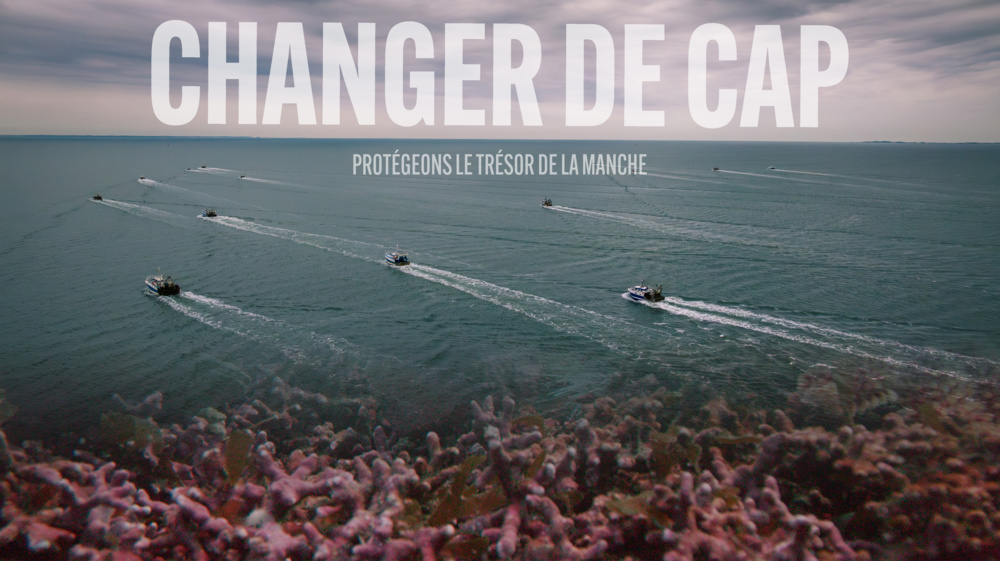
Chausey's 'pink treasure': new EJF film reveals the centuries-old seabed at stake off the Normandy coast
A new short film from the Environmental Justice Foundation (EJF), released today as part of the "Chausey Trésor Rose" campaign, takes viewers beneath the waters of the Chausey archipelago to reveal one of the English Channel's most remarkable and least-known habitats: its maerl beds.
Changer de cap: Protégeons le trésor de la Manche (Change course: Let's protect the Channel's treasure), directed and produced by the EJF, sets footage of the living seabed within a marine protected area, alongside the voices of the fishers and local people whose futures are bound up with it. Nicknamed the 'pink treasure', maerl is a coralline algae that grows by less than 1mm a year and takes centuries to form, yet can be crushed in minutes by bottom-towed fishing gear. The film weighs that fragility against the everyday reality of a working coast, and asks what it will take to protect both.
Maerl beds are living architecture. They form dense underwater meadows that shelter marine life, act as nurseries for commercially important species including scallops, lobsters, sole and clams, and help to store carbon. What is lost today cannot be rebuilt within a generation.
“Chausey’s fishers and marine life depend on the same healthy seabed. This film shows what is at stake, but the decision now lies with the authorities. The fisheries risk assessment must lead to real protection for maerl beds, alongside practical support for fishers whose livelihoods will be affected,” said Marie Colombier, Senior Ocean Campaigner at EJF.
Chausey is a marine protected area (EU Natura 2000 site), protected on paper under European law and the OSPAR Convention. In practice, its maerl beds continue to be degraded by dredging and bottom trawling. EJF's report on the regulation of bottom trawling in France's marine protected areas found the practice is still permitted in most of the country's marine Natura 2000 sites, and identified serious shortcomings in the fisheries risk assessments meant to keep sensitive habitats safe.
The film is one part of a wider effort by EJF and its partners to turn Chausey's paper protection into real protection. In February 2025, EJF and Défense des Milieux Aquatiques (DMA) brought legal action over bottom trawling at Chausey and the neighbouring Bancs des Flandres, taking the Chausey case to France's highest court, the Conseil d'État. In 2026, a French court ruled that Natura 2000 protection measures in the Banc des Flandres site must be effective, not merely nominal, a principle with implications well beyond these two sites.
A fisheries risk assessment for Chausey is now under way, and its outcome will decide whether the archipelago's most sensitive habitats are finally shielded from bottom-towed gear. EJF and Manche Nature are following it closely. On 6 October, the two organisations will meet the prefect of Manche, Marc Chappuis, in Saint-Lô (Normandy) to hand over a petition and press for decisions that match what is at stake, one of a series of advocacy actions alongside the campaign's public roundtable in Granville in June and the legal challenge still before the courts.
Together, the film, the report, the petition and the litigation carry a single message: protected areas must be protected in practice, not just on maps.
ENDS
Notes to editors
The short film, Changer de cap: Protégeons le trésor de la Manche (Change course: Let's protect the Channel's treasure), produced by EJF as part of the "Chausey Trésor Rose" campaign, can be watched here. The images in this film are entirely real and were not generated with AI tools.
EJF's report on the regulation of bottom trawling in France's marine protected areas, published in June 2026, is available here.
About EJF
Our work to secure environmental justice aims to protect our global climate, ocean, forests, wetlands, wildlife and defend the fundamental human right to a secure natural environment, recognising that all other rights are contingent on this. EJF works internationally to inform policy and drive systemic, durable reforms to protect our environment and defend human rights. We investigate and expose abuses and support environmental defenders, Indigenous peoples, communities, and independent journalists on the frontlines of environmental injustice. Our campaigns aim to secure peaceful, equitable and sustainable futures. Our investigators, researchers, filmmakers, and campaigners work with grassroots partners and environmental defenders across the globe.
For more information or to organise an interview with one of our team, please contact media@ejfoundation.org.
SIGN UP FOR OUR EMAILS AND STAY UP TO DATE WITH EJF