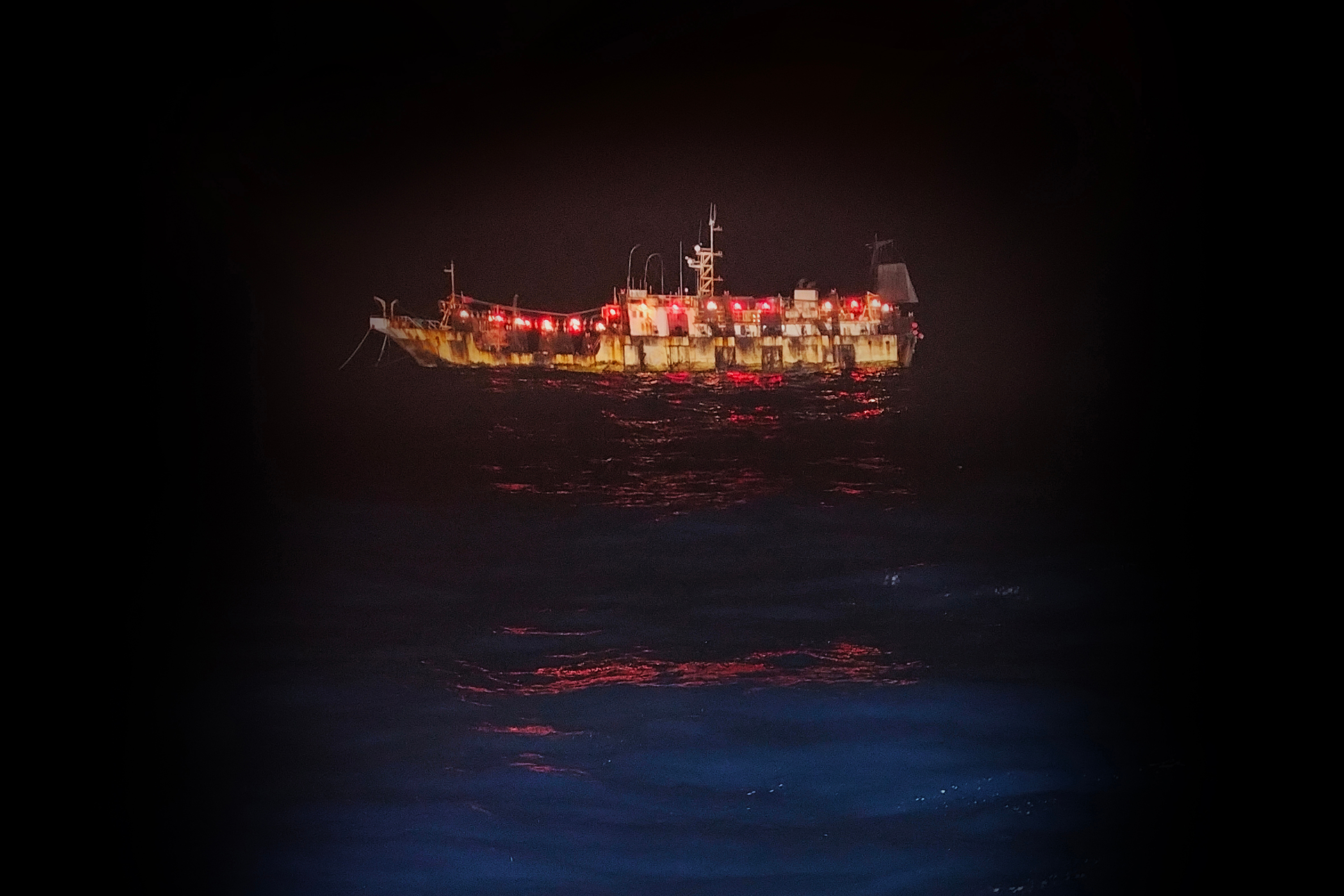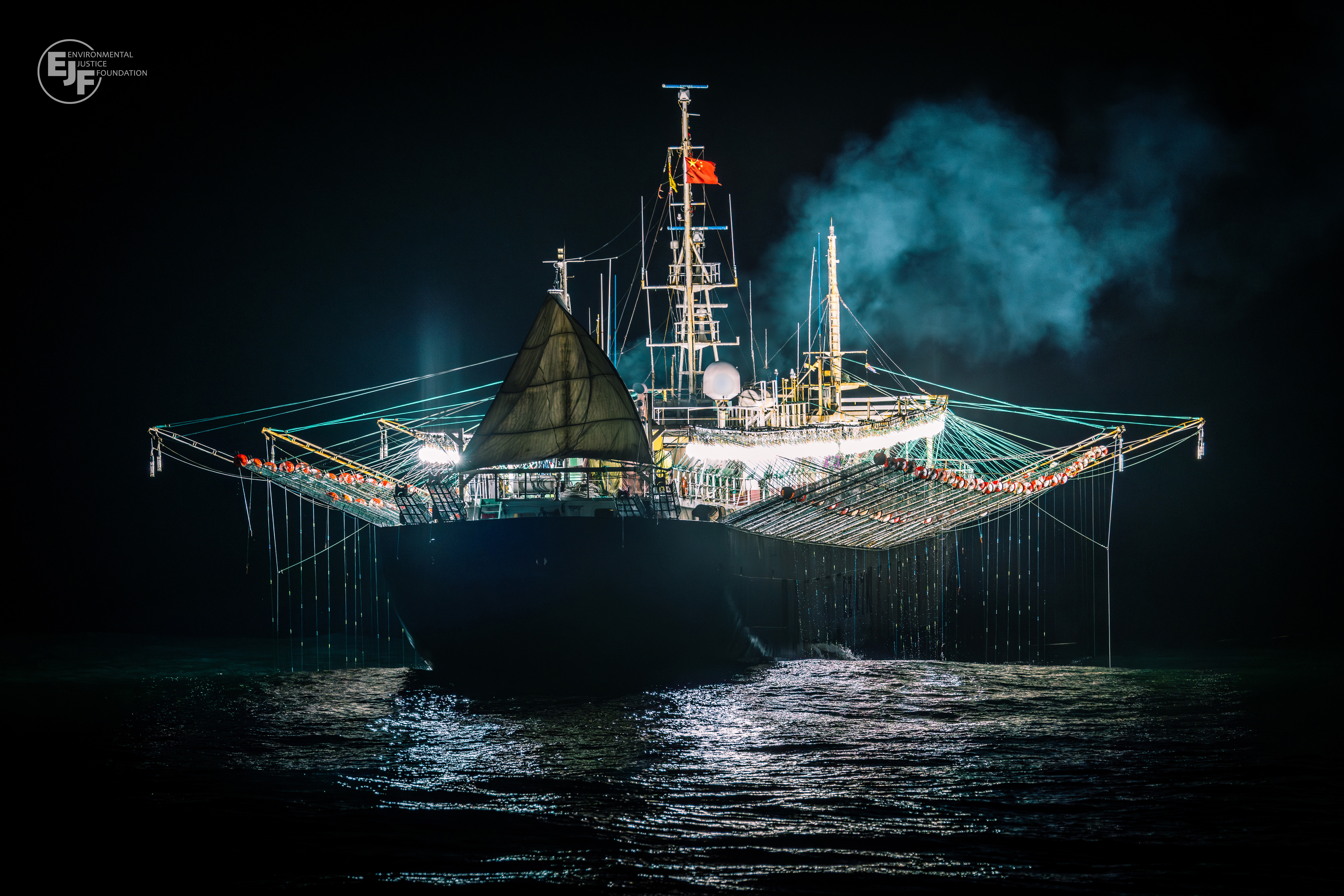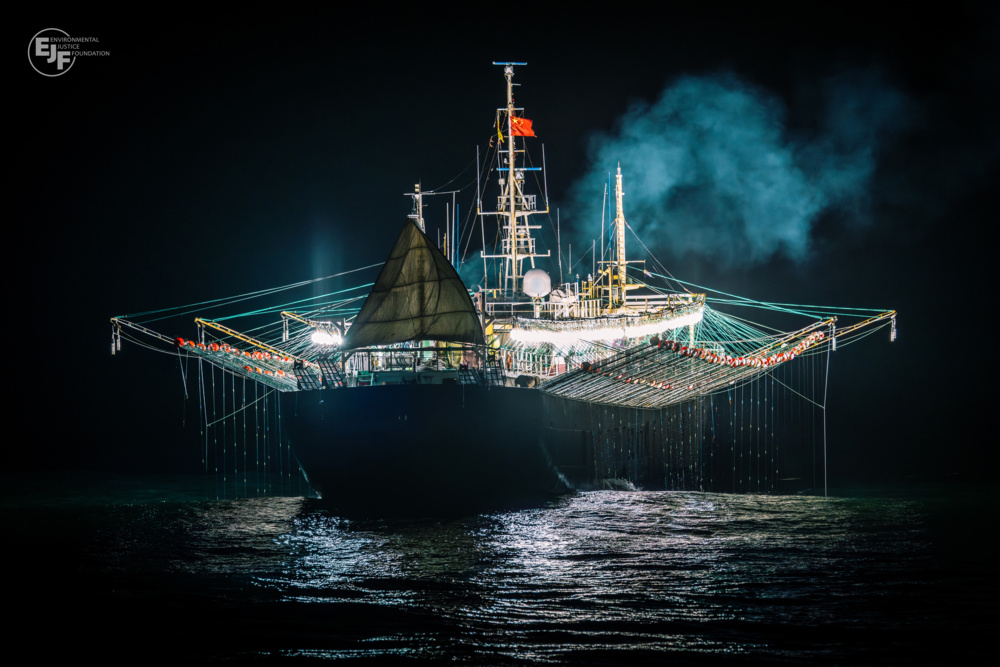
Global squid fleets exposed: new investigation reveals rampant forced labour, illegal fishing and abuse
A new investigation by the Environmental Justice Foundation (EJF) reveals widespread illegal fishing, environmental destruction and severe human rights abuses across the global squid industry, one of the world's most poorly governed seafood sectors.
Drawing on five years of research and more than 430 interviews with Indonesian and Filipino fishers working aboard 249 distant water fishing vessels, the report, one of the most comprehensive ever published, exposes systemic failures across three major squid fisheries in the Northwest Indian Ocean, Southeast Pacific and Southwest Atlantic, which together supply around 60% of the world’s squid.
The findings reveal that these fisheries operate largely beyond effective oversight, creating conditions in which abuses flourish unchecked. Fishers described violence, wage theft and repeated deaths at sea, alongside widespread shark finning and the capture of vulnerable marine species. Almost all interviewees reported at-sea trans-shipment, a practice that allows vessels to remain at sea for extended periods, obscuring the origin of catches and enabling illegal or unsustainable products to enter global supply chains.
The investigation found that conditions deteriorate significantly on longer voyages. On vessels operating for more than a year without returning to port, reports of physical abuse and environmentally destructive practices increased sharply.
China’s distant water squid fleet, the largest in the world, was associated with the most severe outcomes across nearly every indicator measured, including labour abuses, illegal practices and environmental harm. The scale and opacity of these operations raise serious concerns for global seafood markets, says EJF.
Steve Trent, CEO and Founder of EJF, said: “What this investigation reveals is a systemic failure of governance on the high seas. In the absence of transparency and effective regulation, illegal fishing, environmental destruction and human rights abuses are not exceptions; they are the norm.”
“These products are entering global markets every day. Without urgent action, consumers, retailers and governments risk being complicit in a system built on exploitation and secrecy. There is a clear path forward. Governments must enforce transparency across seafood supply chains and fully implement the Global Charter for Fisheries Transparency. At the same time, we need decisive multilateral action to bring these fisheries under effective management and to ensure that the rights of fishers, and the health of our ocean, are protected.”
The report highlights a fundamental regulatory gap: large-scale industrial fishing is taking place in areas beyond national jurisdiction with limited or no effective governance. Existing regional fisheries management frameworks have failed to keep pace.
EJF is calling for urgent action from governments, industry and international bodies, including stronger oversight of distant water fleets, strict regulation of trans-shipment, limits on time spent at sea, and improved labour protections for fishers. Market states, including major seafood importers, must also strengthen controls to prevent products linked to illegal fishing and forced labour from entering supply chains.
By combining strong enforcement, transparency and international cooperation, governments can make rapid progress towards sustainable, legal and ethical fisheries, says the NGO.
EJF is calling for:
- Urgent action from governments, industry and international bodies, including stronger oversight of distant water fleets.
- Strict regulation of trans-shipment, limits on time spent at sea, and improved labour protections for fishers.
- Market states, including major seafood importers, must also strengthen controls to prevent products linked to illegal fishing and forced labour from entering supply chains. The report highlights a fundamental regulatory gap: large-scale industrial fishing is taking place in areas beyond national jurisdiction with limited or no effective governance. Existing regional fisheries management frameworks have failed to keep pace.
ENDS
Notes to editors
Report, video and other materials
- You can read EJF's report OUT OF SIGHT, OUT OF CONTROL: The global boom in destructive squid fishing, here.
- Check maps and other materials from the report here
- Watch the film here
Quotes from the report
- “The [shark] bodies were sometimes thrown away, only the fins were taken[...]If they were all gathered, there would be a lot, probably around a ton. There really were quite a lot of them [fins]. They were put into sacks first before being stored in the freezer.”
Interview with an Indonesian fisher working onboard a Taiwanese-flagged squid/saury vessel operating in the SWA, January 2023. - “A turtle was used as bait. It was only used once. The turtle was accidentally caught in the net, we wanted to help release it but the captain directed us to use it as bait. It was there for almost three months, the turtle was severely wounded. The turtle attracted many squids and fish, we had a great catch.”
Interview with a Filipino fisher working on a Chinese-flagged light seiner operating in the NWIO, June 2023. - “When we refused to fish, we got scolded and physically abused[...]We were kicked and hit[...]I experienced it often. It depended on us. If we were diligent, we would not be kicked[...]There was a moment when I was asked to fish, but I slept in the machine room. I was kicked by the captain.”
Interview with an Indonesian fisher working onboard a Chinese-flagged light seiner vessel operating in the NWIO, July 2022. - "Speaking of physical abuse[...]It was frequent. I almost saw it every day. A crew member who was still
young, below 20 years old.[...]He was frequently hit. Even his pants were once pulled until they ripped.”
Interview with an Indonesian fisher working onboard a Korean-flagged squid vessel operating in the SWA, January 2024. - “Without any warning, he was immediately beaten, choked, and kicked. He was beaten up from the work area all the way down to the hold. Yes, he was beaten up, and he was also being chased. The captain and the bosun acted like it was normal. One of them even laughed. They only watched. When we were punched or beaten up, they would just watch us.”
Interview with an Indonesian fisher working on a Chinese-flagged light seiner operating in the NWIO, June 2025.
About EJF
Our work to secure environmental justice aims to protect our global climate, ocean, forests, wetlands, wildlife and defend the fundamental human right to a secure natural environment, recognising that all other rights are contingent on this. EJF works internationally to inform policy and drive systemic, durable reforms to protect our environment and defend human rights. We investigate and expose abuses and support environmental defenders, Indigenous peoples, communities, and independent journalists on the frontlines of environmental injustice. Our campaigns aim to secure peaceful, equitable and sustainable futures. Our investigators, researchers, filmmakers, and campaigners work with grassroots partners and environmental defenders across the globe. For more information or to organise an interview with one of our team, please contact media@ejfoundation.org.
SIGN UP FOR OUR EMAILS AND STAY UP TO DATE WITH EJF