The European Ocean Act: Securing Europe’s Ocean Future: Europe’s future security, competitiveness and resilience will be decided at sea. The European Ocean Act is a unique opportunity to establish the common operating framework Europe currently lacks: transparent information and decision-making, predictable rules, coordinated planning and measurable accountability across maritime sectors and borders. This policy briefing lays out two strategic imperatives for the Ocean Act.
Europe’s future security, competitiveness and resilience will be decided at sea. The European Ocean Act is a unique opportunity to establish the common operating framework Europe currently lacks: transparent information and decision-making, predictable rules, coordinated planning and measurable accountability across maritime sectors and borders. This policy briefing lays out two strategic imperatives for the Ocean Act.
You can also read the French version here and the Spanish version here.
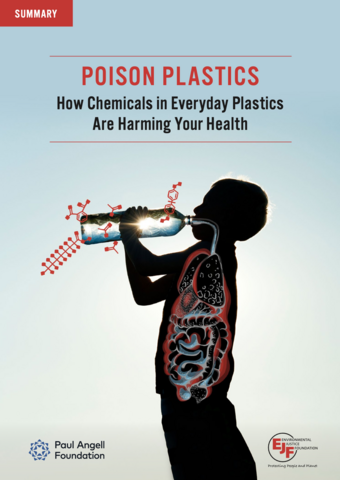
Poison Plastics: How chemicals in everyday plastics are harming your health - Report Summary: Plastics and the chemicals they contain have become deeply embedded in our lives within only a single generation. They are found in the vast majority of items we rely on every day – from food packaging and takeaway containers to clothing, furniture, hygiene products, infant feeding bottles and children’s toys. This summary of our full report shares our novel analyses of the PlastChem data to shed light on the risks presented to human health by everyday items containing plastic-associated chemicals. The findings make the case for a world where the products we use every day are safe by design; today, they are not.
Plastics and the chemicals they contain have become deeply embedded in our lives within only a single generation. They are found in the vast majority of items we rely on every day – from food packaging and takeaway containers to clothing, furniture, hygiene products, infant feeding bottles and children’s toys.
This summary of our full report shares our novel analyses of the PlastChem data to shed light on the risks presented to human health by everyday items containing plastic-associated chemicals. The findings make the case for a world where the products we use every day are safe by design; today, they are not.
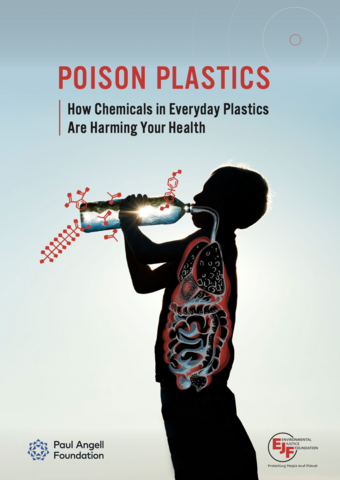
Poison Plastics: How chemicals in everyday plastics are harming your health: Plastics and the chemicals they contain have become deeply embedded in our lives within only a single generation. They are found in the vast majority of items we rely on every day – from food packaging and takeaway containers to clothing, furniture, hygiene products, infant feeding bottles and children’s toys. This report shares our novel analyses of the PlastChem data to shed light on the risks presented to human health by everyday items containing plastic-associated chemicals. The findings make the case for a world where the products we use every day are safe by design; today, they are not.
Plastics and the chemicals they contain have become deeply embedded in our lives within only a single generation. They are found in the vast majority of items we rely on every day – from food packaging and takeaway containers to clothing, furniture, hygiene products, infant feeding bottles and children’s toys.
This report shares our novel analyses of the PlastChem data to shed light on the risks presented to human health by everyday items containing plastic-associated chemicals. The findings make the case for a world where the products we use every day are safe by design; today, they are not.
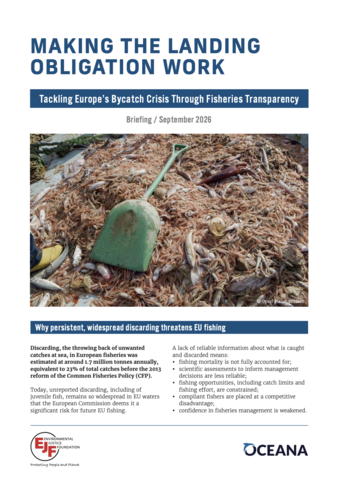
Making the Landing Obligation Work: Tackling Europe’s Bycatch Crisis Through Fisheries Transparency - Summary: The EU’s Landing Obligation (LO) is intended to reduce waste, encourage selective fishing and improve the catch information used to manage populations. For catches within the LO scope, fishers must retain, record and land catches, including bycatch, and count them against quota where applicable, subject to defined exemptions. More than a decade after the obligation was phased in, and seven years after it became fully applicable, these objectives have not been achieved. This is a summary of the longer briefing from EJF and Oceana, which provides a roadmap for ensuring the EU Landing Obligation’s full implementation.
The EU’s Landing Obligation (LO) is intended to reduce waste, encourage selective fishing and improve the catch information used to manage populations. For catches within the LO scope, fishers must retain, record and land catches, including bycatch, and count them against quota where applicable, subject to defined exemptions. More than a decade after the obligation was phased in, and seven years after it became fully applicable, these objectives have not been achieved.
This is a summary of the the longer briefing from EJF and Oceana, which provides a roadmap for ensuring the EU Landing Obligation’s full implementation.
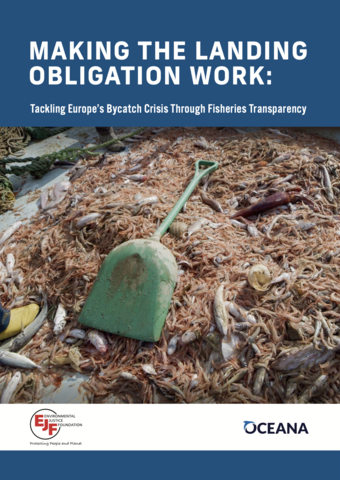
Making the Landing Obligation Work: Tackling Europe’s Bycatch Crisis Through Fisheries Transparency: The EU’s Landing Obligation (LO) is intended to reduce waste, encourage selective fishing and improve the catch information used to manage populations. For catches within the LO scope, fishers must retain, record and land catches, including bycatch, and count them against quota where applicable, subject to defined exemptions. More than a decade after the obligation was phased in, and seven years after it became fully applicable, these objectives have not been achieved. This briefing from EJF and Oceana provides a roadmap for ensuring the EU Landing Obligation’s full implementation.
The EU’s Landing Obligation (LO) is intended to reduce waste, encourage selective fishing and improve the catch information used to manage populations. For catches within the LO scope, fishers must retain, record and land catches, including bycatch, and count them against quota where applicable, subject to defined exemptions. More than a decade after the obligation was phased in, and seven years after it became fully applicable, these objectives have not been achieved.
This briefing from EJF and Oceana provides a roadmap for ensuring the EU Landing Obligation’s full implementation.
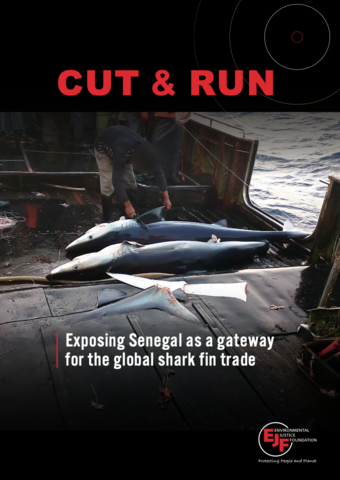
Cut & Run: Exposing Senegal as a gateway for the global shark fin trade: This report reveals extensive shark finning on board Chinese and Taiwanese-owned tuna vessels that call at Dakar, Senegal's main fishing port. Drawing on first-hand testimony from fishers who witnessed this cruel and often illegal practice, the report exposes how fins were routinely landed in Dakar, with enforcement at the port easily evaded or non-existent. It also reveals the high risk of tuna linked to shark finning entering global supply chains. Without urgent action from Senegal and international regulators to close these loopholes, the trade of shark fins will continue unchecked.
This report reveals extensive shark finning on board Chinese and Taiwanese-owned tuna vessels that call at Dakar, Senegal's main fishing port. Drawing on first-hand testimony from fishers who witnessed this cruel and often illegal practice, the report exposes how fins were routinely landed in Dakar, with enforcement at the port easily evaded or non-existent. It also reveals the high risk of tuna linked to shark finning entering global supply chains. Without urgent action from Senegal and international regulators to close these loopholes, the trade of shark fins will continue unchecked.
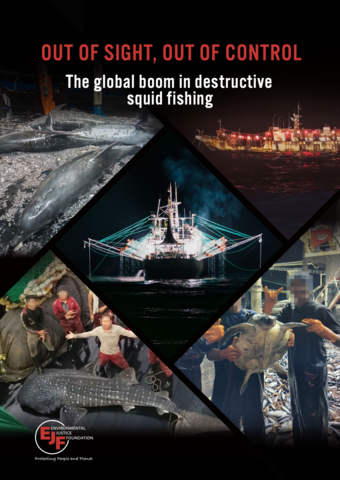
OUT OF SIGHT, OUT OF CONTROL: The global boom in destructive squid fishing: The Environmental Justice Foundation's new global report exposes what happens aboard distant-water squid vessels operating beyond any oversight, forced labour, physical violence, and deaths at sea across fisheries that supply 60% of the world's squid. The European Union is the world's largest squid importer. What happens out of sight has consequences here.
The Environmental Justice Foundation's new global report exposes what happens aboard distant-water squid vessels operating beyond any oversight, forced labour, physical violence, and deaths at sea across fisheries that supply 60% of the world's squid.
The European Union is the world's largest squid importer. What happens out of sight has consequences here.
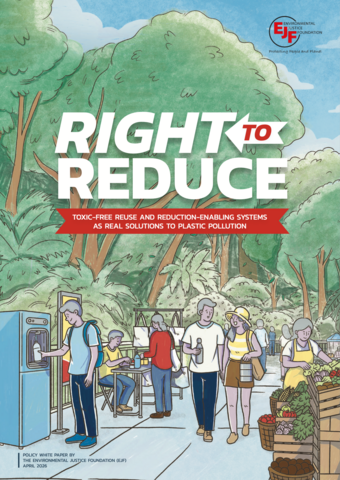
Right to Reduce: Toxic-free reuse and reduction-enabling systems as real solutions to plastic pollution: The "Right to Reduce" is a concept created by the Environmental Justice Foundation. This policy white paper asserts that the ability to reduce consumption of plastics and materials is a human right. It shows that today, individuals are systematically denied the right to reduce due to the dominance of plastics in everyday life, leaving people with little meaningful ability to avoid plastic consumption. This right to reduce is guaranteed by establishing toxic-free reduction-enabling systems, challenging the current system of plastic overproduction and overconsumption, and rejecting false solutions.
The "Right to Reduce" is a concept created by the Environmental Justice Foundation. This policy white paper asserts that the ability to reduce consumption of plastics and materials is a human right. It shows that today, individuals are systematically denied the right to reduce due to the dominance of plastics in everyday life, leaving people with little meaningful ability to avoid plastic consumption.
This right to reduce is guaranteed by establishing toxic-free reduction-enabling systems, challenging the current system of plastic overproduction and overconsumption, and rejecting false solutions.

Joint letter to Cyprus EU Presidency: Upholding the common fisheries policy at the EU Fisheries Directors General and Attachés informal meeting in Cyprus: This letter, signed by the Environmental Justice Foundation, Coalition Clean Baltic, ClientEarth, Oceana, Seas At Risk and WWF EU, urges Mrs Marina Argyrou, Director of the Department of Fisheries and Marine Research of Cyprus and presiding over the informal meeting of EU Fisheries Directors General and Attachés (26-28 April 2026), to resist growing pressure from some Member States to reopen core fisheries legislation under a so-called "simplification package", and to prioritise the full and timely implementation of existing Common Fisheries Policy (CFP) provisions as a prerequisite to achieving sustainable EU fisheries.
This letter, signed by the Environmental Justice Foundation, Coalition Clean Baltic, ClientEarth, Oceana, Seas At Risk and WWF EU, urges Mrs Marina Argyrou, Director of the Department of Fisheries and Marine Research of Cyprus and presiding over the informal meeting of EU Fisheries Directors General and Attachés (26-28 April 2026), to resist growing pressure from some Member States to reopen core fisheries legislation under a so-called "simplification package", and to prioritise the full and timely implementation of existing Common Fisheries Policy (CFP) provisions as a prerequisite to achieving sustainable EU fisheries.
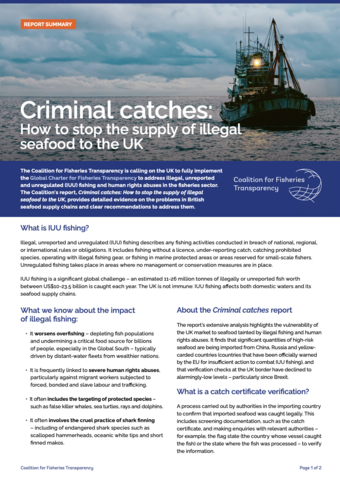
Criminal catches: How to stop the supply of illegal seafood to the UK - Report Summary: The Coalition for Fisheries Transparency is calling on the UK to fully implement the Global Charter for Fisheries Transparency to address illegal, unreported and unregulated (IUU) fishing and human rights abuses in the fisheries sector. The Coalition's report, Criminal catches: How to stop the supply of illegal seafood to the UK, provides detailed evidence on the problems in British seafood supply chains and clear recommendations to address them.
The Coalition for Fisheries Transparency is calling on the UK to fully implement the Global Charter for Fisheries Transparency to address illegal, unreported and unregulated (IUU) fishing and human rights abuses in the fisheries sector. The Coalition's report, Criminal catches: How to stop the supply of illegal seafood to the UK, provides detailed evidence on the problems in British seafood supply chains and clear recommendations to address them.

EJF’s Policy Brief on Climate Finance: This briefing sets out why climate finance is the foundation for reforming the global economic system. Drawing on 2024 research published in Nature, it shows that investing US$6 trillion in mitigation now, a sixth of the US$38 trillion cost of inaction, would secure a Paris-aligned future and spare the poorest regions the steepest income losses, with median income falling by around 11% in North America and Europe and 22% in South Asia and Africa within 26 years. It argues that closing the mitigation, adaptation and loss and damage finance gaps demands greater transparency, climate-focused policy, divestment from fossil fuels and incentives for a real zero-carbon economy by 2035.
This briefing sets out why climate finance is the foundation for reforming the global economic system. Drawing on 2024 research published in Nature, it shows that investing US$6 trillion in mitigation now, a sixth of the US$38 trillion cost of inaction, would secure a Paris-aligned future and spare the poorest regions the steepest income losses, with median income falling by around 11% in North America and Europe and 22% in South Asia and Africa within 26 years. It argues that closing the mitigation, adaptation and loss and damage finance gaps demands greater transparency, climate-focused policy, divestment from fossil fuels and incentives for a real zero-carbon economy by 2035.

A Manifesto from the Species of the Pantanal: This manifesto calls for urgent action to protect the world's largest tropical wetland, the Pantanal, on behalf of the species that inhabit it. This landmark manifesto has been signed by 16 leading conservation organisations.